Danny Lenihan tells the story of how 3 Legged Thing began.
Everyone loves a nice happy ending. Me? I prefer a good origin story. And if I'm completely truthful, 3 Legged Thing has a pretty decent one of those, even if I say so myself.
It all started in 2010. I owned a small studio lighting company, and I was looking for a less niche, more commercial venture. I'd already designed a couple of tripodsÑthe ePod and the ePod Diversity Ñ for the lighting company. These were studio tripods with mounting points for laptops and multiple cameras. Both were very successful (in relative terms), and this gave me an idea.
Initially, I thought about setting up an online tripod store, where I would stock every brand and model that existed, to make a one-stop-shop for tripod enthusiasts (my name is Danny, and I'm a tripodaholic...), and give a catalyst to my own-designed models.
Then, as the idea developed, it transitioned to "why can't everyone else sell the products I design?". It was a fair question. I'd proven already that I had an eye for innovation in this arena, so why shouldn't I think about broadening my horizons?

It took me back to my youth, as a teenage guitarist in the rock band "Cruel to be Kind", before I quit and formed the significantly worse "Non-Green Wardrobes" (NGW). I didn't want to be stuck playing The Grey Horse in Kingston, or The Bun Shop in Berrylands. I wanted to be front and centre at Wembley Stadium, with a stack of Marshall amps and a '69 Les Paul cherry sunburst, peeling knickers off my face as they hit me from the hundred thousand strong crowd that were screaming and singing along to such classics as "Laurie's Wardrobe" and "Four Minutes 'Til My Face Melts". Rock on.
Now, I'll be the first to admit that my musical aspirations may well have been a tad above my talent capabilities, but that didn't mean I shouldn't at least try. I failed miserably (until much later in my life, but that's another story) but I learned some valuable lessons on the way.
For example; just supposing that someone booked the iconic NGW to play Wembley, probably with some small-time loser band, like Led Zeppelin or Queen in support, we'd have crashed and burned spectacularly, because the songs were awful, and we were sensationally talentless with our instruments, even if we'd deluded ourselves into believing the world needed our rock apocalypse.
The same is true for products. You can have the world's largest database of buyers, and connections with 5000 stores in a hundred countries, but if your product is bad, you'll destroy your reputation at the first hurdle.

I had an entirely different issue. I knew I could deliver a great product. And I knew, given enough time and resource, I'd be able to convert sales to stores around the world. What I couldn't fathom was how to make an impact. How to create a unique selling point, or a brand message that would resonate, not just with stores and their buyers, but with consumers and photographers.
You'd be astounded how often someone invents a world-changing product but ends up binning it because they just don't know how to get the message out there. It's not even about "what does it do?" or "who is it for?" at that stage. These are fundamental questions that require answering, but before you even get to that point, you need to be shouting "Here it is!"
I knew I could get people to look, as I'd already done it. I could generate the audience, perhaps with a little help, but the real challenge wasn't getting people to look. It was getting them to pay attention. To take notice. To look twice.
If I entered the market with another 'same-same' tripod and a weak brand, the idea was buried before it had even started. I needed something truly different.
Now, I'm not advocating a relationship with alcohol, but in the early days some of my more wayward ideas were very much the result of "thinking under the influence". I realised pretty quickly that allowing Jack Daniels to be my spokesperson was probably a poor idea, but it gave rise to some interesting thoughts.
I've found, throughout my life, that unconventional approaches are often the result of non-conformist thinking, and that getting trapped in a corporate hierarchy was the quickest way to suppress original thought. I'd spent years looking at competitor products, and being frustrated by their limitations and aesthetic cloning, so I devised a list of things that bothered me. It wasn't an especially lengthy list, but it was powerfully suggestive, and led me to a variety of conclusions.
Foremost was the brand identity. Now, I'm happy to agree that there are some great tripod brands around, some of which have been around for decades, and have truly influenced modern camera support technology. A couple were a photographic equivalent of a household nameÑboth well-known and well respected in the photography community.
Others were a little more obscure, but very product focussed, and essentially all about 'enabling' photographers. I loved this approachÑsurely, assisting in workflow, and user experience should be a dominant characteristic of those in the privileged position of influencing photographic generations?
I looked at the list I'd procured of the top twenty best-selling tripods in the current marketplace, and what stood out the most was that it didn't feature any of the more radical designs I'd unearthed in my research. There really was a tremendous gap between commercial viability and innovation.

The original Chicken Shed, which has recently been knocked down.
It seemed, on the face of it, that those brands with the loudest voices and the deepest pockets could dominate the market space, ad infinitum. There were no challengers to the status quo, despite plenty of (in my opinion) better alternatives to the big hitters.
That's where I really drew focus. I knew I had neither the budget nor the voice to take on the big players. Who does? What I had was a great product, with lots of new ideas, that were designed to improve workflow and user experience.
But then, so did many of the brands I'd researched, so why weren't they more prevalent in the market space? That's when it hit me. The simplicity of the truth. They were all doing the exact same thing. The message was vanilla and uninspiring, despite the obvious brilliance of the technology. Worse still, they weren't part of the conversation. Even the most cursory of glances at photography forums and articles showed exactly what I expectedÑeverybody was talking about the big brands.
I should point out at this stage that there's no suggestion from me that the larger, more successful brands weren't making great products. Whilst what I said earlier is true; you can have the best product in the world, but if nobody knows about it, you won't sell any. The opposite is also true. You can have the biggest marketing budget in the world, but if the product doesn't stand up to scrutiny, it will also fail. And the big brands weren't failing. Au contraire!
The problem was getting the message out there. I didn't have a big budget. This was a start-up brand that I'd kicked into life with a £7000 loan from my lighting company. I had some brilliant designs and ideas, but in order to succeed, I needed deeper pockets, and with that came an inherent risk. It was still an enormous gamble. I wasn't part of the conversation.
What I needed was an idea that got people talking. An original thought that sparked debate. I needed a product that stood out from the crowd, and a brand with a unique set of ideals.
I went back to my list, and the top two notable lines declared: all tripods look the same. All brands were riding the same bandwagon.
I'll circle back to the first point later. The bandwagon intrigued me the most.
2010 was the time when travel tripods really exploded. The innovations from the early 1980s that Gitzo brought to the market were now off-patent, and the photography world was steaming forward with developing their own versions with counter-fold legs and a detachable monopod leg. It was like tripod manufacturers had only just cottoned on to what Gitzo knew in 1983Ñpeople travel with their cameras.
The notable exception to this was Manfrotto, whose parent company, Vitec (now Videndum), had purchased Gitzo just two years after acquiring the Italian giant in 1991. It implied that they didn't want their biggest brand to encroach upon the original thinking of their premium offering, which opened the door to the smaller brands to move into that exciting new market space and deliver a lower-priced alternative.
I knew what I had to do. The pathway was so clear to me. Travel tripods were the opportunity to get started. They weren't (yet) at saturation point, and there was plenty of scope to deliver some of my design ideas in a smaller package.

What I needed now was some fireworks. Cue the late-night sessions with my friend and mentor Jack Daniels. I had a vision for success that revolved around a simple conceptÑenable and inspire.
The brand identity was a moving feast. At this stage I'd vetoed such incredible submissions as "Danfrotto" and "Legless With Legs", but the latter had given me pause for thought. It was at a team meeting in early July 2010 that I first heard the words "3 Legged". One of my original team members floated the idea of calling the brand "3 Legged Fish", which had us in stitches for about ten minutes, before saner heads prevailed and the idea was extinguished.
Something about it resonated though, and I couldn't shake the thought that we were close to finding greatness, which was clawing at the back of my mind, somewhere behind my ego, I expect. "What is it?" was the question I was asking the team daily. "A tripod" was the most common response. The second most common was an eye roll and a vulgar gesticulation behind my back. Fair.
It wasn't until we'd spent a week throwing out some truly horrendous suggestions (Danfrotto was back on the table) that, in my frustration, I held aloft one of the original samples like He-man calling on the power of Greyskull and asked, "What is this thing?"
It was like a lightbulb coming on. Suddenly, the room felt illuminated with opportunity. The "3 Legged Thing" in my hands was the conversation starter I'd been looking for. I'd love to say that there was a wringing of hands, and the champagne flowed as we celebrated our obvious genius, but in reality, I had to settle for some weary nods from a team that no longer cared as long as they got paid. Heathens.
The idea took hold, though, and over the next few days, the enthusiasm grew. I spent most of the following week designing a logo with crayons and limited Photoshop skills, before I handed the final concept to our resident artist to make shiny.
It was too early to bounce around shouting "Flawless Victory!" like we were the messiahs of Mortal Kombat, but spirits were high, and momentum was a commodity not to be wasted.
The brand identity itself wasn't enough to get the conversation going. We needed something to talk about. A message to our future customers. The products were a constant discussion point, and it was only a few days after our brand epiphany that someone dubbed the first prototype "Brian" so that we didn't have to keep calling it "the first prototype". I remember that moment so clearly. "I want to break free" was wafting from one of the office computers, complete with the world's worst guitar solo. Brian, it appeared, was giving his blessing.

That's when we really started the conversation. Initially, I'll admit to being a little sceptical of the idea, but the more it fermented, the more it made sense. More than once in my life I'd gone to look at a specific product, but misremembered the model, which led to confusion and frustration. Why were they all given such complicated alpha-numeric identities? Why couldn't we defy convention and call a tripod, Brian?
The answer was very simple. We could do whatever we liked.
It was exactly the sort of original thinking that would get people talking. I didn't yet know much about retailers, but I knew what it was to be a photographic consumer, and we'd already committed to making user experience a main focal point.
Naming Brian really spawned a lot of ideas that eventually become our legacy. It also caused a ripple effect that swept through the photographic industry. And it wasn't the only idea of ours that changed the market...
During a trip to Shanghai Imaging, an annual pilgrimage for me, whilst meeting with various manufacturing partners to discuss 3 Legged Thing, I stumbled across a small booth in the corner, where they were making little tools and keyrings for photographers. The thing that struck me the most was that everything was in colour. Sparkly anodised aluminium glowed from every corner of this ten-foot space, and it really shone. I wondered how I hadn't spotted it earlier.
I pressed the flesh and had a brief conversation before parting with a couple of samples and about fifteen business cards (from just the two workers manning the booth). My immediate priority was to check out the other booths, to see if the idea of coloured merchandise had spread to other product categories. It hadn't.

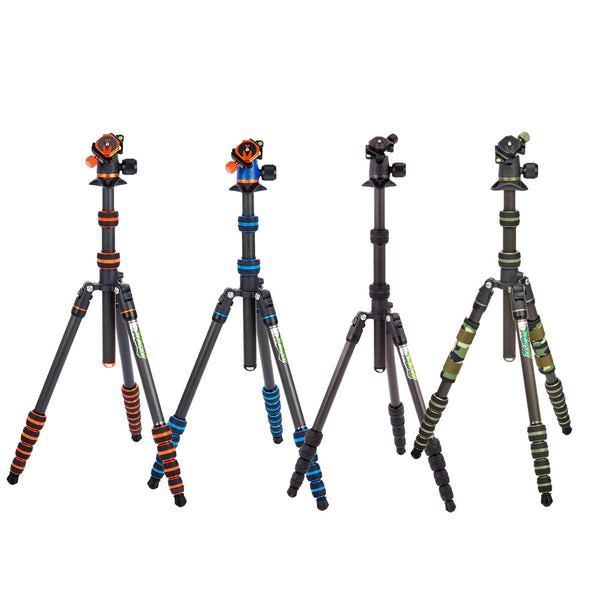
Every tripod in the building was black, with the occasional fleck of silver or raw aluminium. It blew me away. I'd even made some scathing comments in my "what's wrong with this industry list" about the aesthetic cloning that was so prevalent throughout, but it hadn't occurred to me before this moment that what was missing was right in front of my face. Colour.
My mind raced as I grabbed Brian from my bag and started to mentally catalogue the components that could potentially be anodised. The answer was staggering. Almost everything was aluminium, and already anodised in black
 .
.
I floated about the rest of the afternoon in a daze, looking at every tripod I could get my hands on. Everything was black. The whole product sector screamed "lack of imagination" at me. It was the reason everything looked the same. It was also the reason that the big brands were so dominant. In a sea of look-a-likes, the confusion led to a simple conclusion; stick with what you know.
If you don't give people a reason to buy your product, they settle for the basic principle of purchase: "Someone else I know uses this".
It's a powerful motivator for consumersÑpiggybacking on the buying habits and recommendations of their peers. It was a thought process that cut through the confusion and simplified the decision.
That was the moment when I truly realised that innovation wasn't enough to sell a product, when every USP ever determined relied on a base conformity to the status quo.
I barely slept that night. For once, I wasn't being kept awake by my one-year-old daughter, but by my own imagination running rampant and unchecked through my subconscious.
In the twelve years since this moment, I have reflected upon it often. I've spoken to hundreds of entrepreneurs over the years, and it would appear that this moment is what we have in common. It's about fundamentally understanding what is missing from the marketplace. What isn't there that should have been, and could still be?
The answer for me wasn't just "colour". It was individuality. It was that the established brands had failed to understand the basic human premise of the individual. George Orwell once wrote that "all men are created equal, but some are more equal than others." It was this sort of Draconian thinking that could bury a product in a quagmire of indifference.
My ego was back, and I was already discounting Mr. Orwell as an enthusiastic amateur, whilst mentally erecting statues of myself at the entrance to the farm. Nobody had ever confused me with a genius, but I was sure the world would bow to my superiority as I filled photographic hearts with anodised joy.

Okay, so I wasn't the most mentally stable thirty-something, and fourteen years of stand-up comedy had elevated my sense of self-worth to previously unachieved heights of narcissism. I gave myself a virtual slap and got back to the task at hand.
The following day, I went back to the imaging show and made a beeline for my first-choice manufacturing partner. We exchanged pleasantries and then got to the business at hand. I pulled Brian from my bag and asked them if I could make various elements in colour.
"Why would you?" came the response. "Everybody prefers black." I silently wondered how they'd established preferences where a lack of choice existed, but this response at least clarified for me the medieval thinking behind camera accessories.
I made some decisions regarding colour, shook hands with the bemused Chinese factory, and headed back to blighty with a renewed enthusiasm and boundless energy.
Every idea we'd come up with as a team was a bold one. For months, I worried about the comment "everybody prefers black" as I sank more money into manufacturing and building the marketing assets to launch the brand. "Go big or go home" was a phrase often bandied about the office, and this mantra became the backbone for our brand launch in January 2011 (1/1/11 actually!).

Since I was fourteen, skateboarding had been a huge part of my life. Even now, as I approach fifty, my conservatory wall is adorned with skateboards, some signed and of historical significance, and others used (by me) to remind me of the joy it brought. One of the most compelling draws to skateboarding life was the graphic art that was vividly depicted on the underside of seven layers of Canadian maple.
It fed my youthful imagination, and it was only as I glanced at one of my older decksÑmy Powell Peralta Ray Barbee deckÑthat I realised I was still affected as an adult by the art in front of me. I loved the imagination that led to the creation of the Rag Doll graphic by Sean Cliver, and it inspired a conversation with my team that would add the icing on the cake of our new venture.

We imagined huge cartoon monsters, hell-bent on global domination, and commissioned a local artist to recreate some iconic scenes from movie history with our tripods as the protagonists and heroes. We spent months creating an ad campaign that featured these artworks besides the more conventional list of product attributes consumers used to measure a product's worth.
Art continued to be a huge part of our focus for the future, and in 2019 we even paid homage to that incredible Rag Doll, when Ray Barbee himself (yay!) joined our pro team, and George Powell (of Powell Peralta) gave his blessing for our artist, Brooke Thompson, to recreate the rag doll artwork for 3LT. Incidentally, the Barbee Graphic (as it is now known) actually hangs in the head office of Powell Peralta in Santa Barbara, California.

The "Death Aquarium" artwork above was commissioned in 2019 and illustrated by Brooke Thompson. The iconic Animal Chin graphic (on the left) used with kind permission from George Powell (Powell Peralta Skateboards). Artwork paid homage to the skateboarding legend, Mike McGill, and features on the Legends Mike tripod packaging.
The day came when the brand was due to launch. Everyone was nervous. We'd had a million issues on the lead-up to the launch, with websites and servers, shipping delays because of the worst snowfall the UK had seen in four decades, but our minds were set and focussed on the go launch date.
The most interesting thing, when I look back on those early days, was our absolute belief that we would make an impact, coupled with our total lack of confidence as the hour to launch drew nearer. We were second-guessing everything and making last-minute changes everywhere.
When the first tripod sold on our website, to the cheers of everyone in the office, I called the customer in question to thank him for taking the chance on my little company. He turned out to be 92 years old, and when I asked him why he'd chosen us over everything else out there, he replied simply, "It looked cool."
So much has happened since then, but those historic moments lay the foundations for the brand success. Over a decade has passed since our entry into the global arena of tripods, and our mantra remains the same.